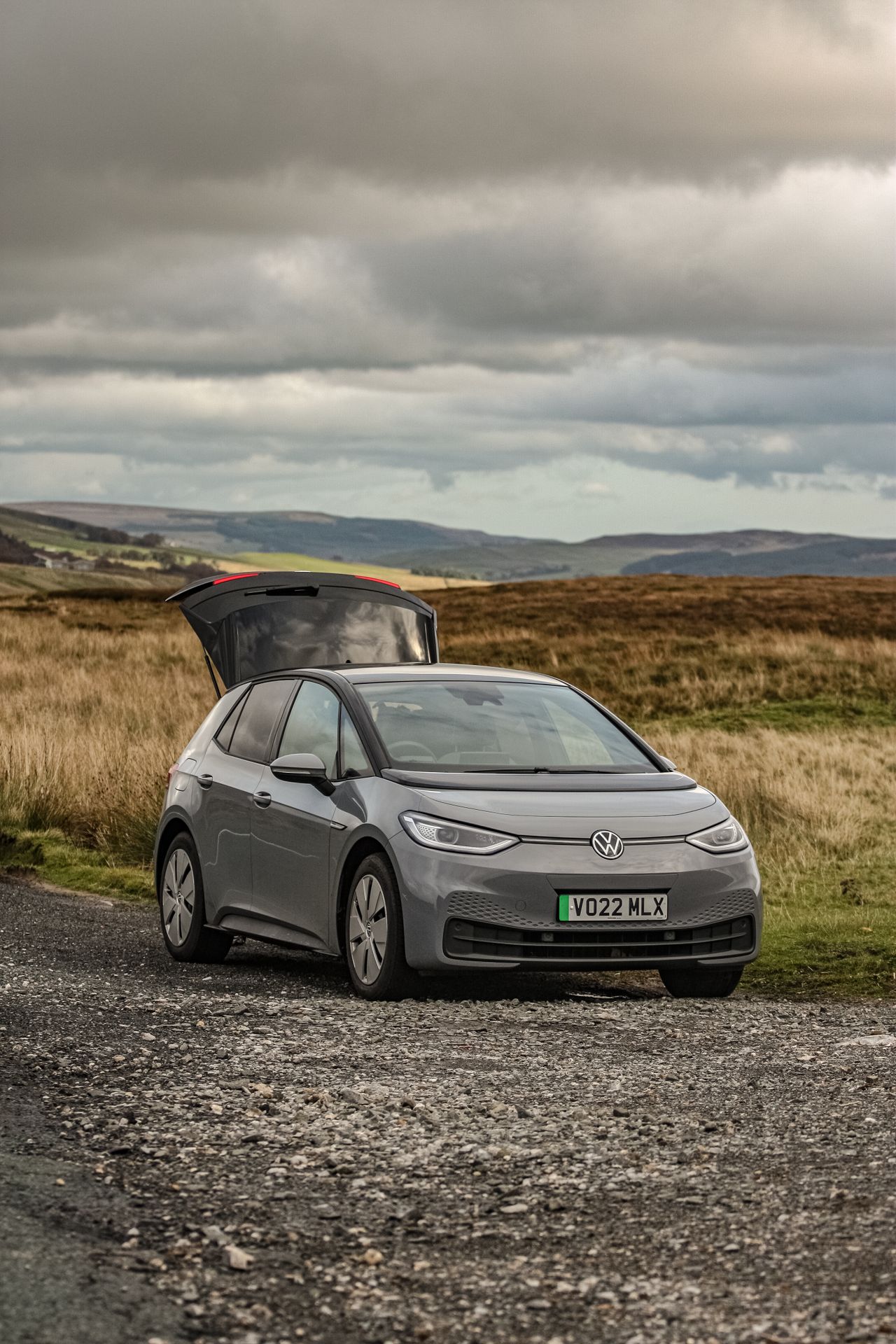
The Volkswagen ID.3 was VW's first car built on a dedicated electric vehicle platform (MEB) — a proper clean-sheet EV design rather than a converted petrol car. As an electric hatchback, it competes with the Nissan Leaf, Renault Zoe, and Tesla Model 3, and offers a more premium, polished driving experience than most rivals at its price point. For Isle of Wight buyers considering an electric car, the island's geography makes a compelling case: short daily distances, home charging overnight, and the ability to cover the whole island on a single charge.
Browse VW ID.3 listings on the Isle of Wight →
Battery Versions and Real-World Range
The ID.3 launched with three battery sizes, though the entry-level 45kWh has been phased out. Current used market options:
45kWh (Pure) — approximately 170–200 miles WLTP. Real-world range roughly 140–160 miles in mixed IoW conditions. Now discontinued but available used.
58kWh (Pro) — approximately 260 miles WLTP. Real-world 210–230 miles. The most common ID.3 in the used market and the practical choice for most buyers.
77kWh (Pro S) — approximately 340 miles WLTP. Real-world 270–300 miles. More range than any IoW buyer needs locally, but reduces range anxiety for frequent mainland trips via ferry.
For pure island use, the 58kWh covers the entire IoW road network multiple times on a single charge. The 45kWh is also entirely adequate for local use, just with less margin.
Charging on the Isle of Wight
Home charging is where island EV ownership shines. Most IoW properties have off-street parking — install a home wallbox charger (7kW is standard) and the ID.3 charges overnight every night, meaning you always start the day with a full battery.
A 7kW wallbox charges the 58kWh battery from near-empty in approximately 8–9 hours. Overnight charging is trivial.
Public charging on the IoW: Public charging infrastructure on the island is growing. Fast chargers (50kW+) are available at selected locations including Newport and Ryde. For mainland travel via ferry, fast chargers are also available at Portsmouth and Southampton ferry terminals.
DC rapid charging: The ID.3 supports up to 100kW DC charging (50kW on entry models). A 100kW charger takes the 58kWh battery from 10–80% in approximately 35 minutes.
Why the ID.3 Works Particularly Well on the Isle of Wight
Distance-perfect for the island. Newport to Cowes is 5 miles. Newport to Ryde is 8 miles. Newport to Ventnor is 10 miles. The longest possible IoW journey is under 25 miles. Any ID.3 battery handles a week of island driving without needing to charge mid-day.
No range anxiety for local use. One of the main EV concerns — worrying about range — simply doesn't exist on the IoW with an ID.3. You charge at home, drive your island journeys, charge again overnight.
Lower running costs. Electricity is cheaper per mile than petrol. Home charging overnight (Economy 7 or off-peak rate) at approximately 12–15p/kWh gives a running cost of roughly 3–4p per mile — around a third of an equivalent petrol hatchback.
No ferry surcharge for EVs. Wightlink and Red Funnel charge the same rate for electric vehicles as petrol cars in the same size category — no premium for being electric.
What to Check When Buying Used
Battery health report: Always request a battery state-of-health check on any used ID.3. VW dealers can pull this from the car's diagnostic system. A healthy ID.3 should show 90%+ battery health. Below 85% on a relatively recent car warrants investigation.
Software version: Early ID.3s launched with software issues that caused infotainment instability and other glitches. VW issued extensive OTA (over-the-air) updates. Check the current software version and ensure the car has received all available updates.
Charging port condition: Inspect the CCS2 DC charging port for damage or corrosion. Replacement is expensive.
Heat pump option: Higher-spec ID.3s were available with a heat pump for cabin heating — this significantly improves winter range efficiency (EVs use battery power for heating, reducing range in cold weather). The heat pump is a worthwhile spec point to look for.
Warranty coverage: ID.3 comes with an 8-year/100,000-mile battery warranty from VW — confirm whether this is still active and transferable on any used example.
Trim Levels and Variants
ID.3 Pure Performance (45kWh, 150hp): Entry — discontinued
ID.3 Pro (58kWh, 150hp/204hp): Most common — good all-round spec
ID.3 Pro Performance (58kWh, 204hp): Faster, same battery
ID.3 Pro S (77kWh, 204hp): Maximum range — rarer, higher residual
ID.3 Tour (58kWh): Full-spec trim with panoramic roof, upgraded audio
For IoW buyers, any Pro variant hits the practical sweet spot — enough range, good equipment, and the most plentiful supply used.
Running Costs Summary
| Cost | Estimate |
|---|---|
| Electricity (home charge, 10,000 miles/yr) | ~£350–450/yr |
| Insurance (group 27–29, experienced driver) | ~£600–900/yr |
| Road tax | £0 (zero-emission) |
| Annual service | ~£100–150 (minimal — no oil, filter service) |
Road tax is free for zero-emission vehicles. Servicing costs are genuinely lower than petrol — no oil changes, far less brake wear (regenerative braking), no exhaust system.
Frequently Asked Questions
Is the VW ID.3 a good electric car for the Isle of Wight? Yes — an excellent match for island life. The IoW is 23 miles long and 13 miles wide. Any ID.3 battery handles a full week of typical island driving without needing a mid-week public charge. Home charging overnight on a 7kW wallbox means you start every day with a full battery. Running costs are genuinely low: roughly 3–4p per mile on home charging versus 14–18p per mile for a petrol equivalent. Road tax is free. There is no motorway on the island — which is exactly where EVs are least efficient — so the ID.3 operates in its optimal environment at all times.
Which ID.3 battery size should I choose? The 58kWh Pro is the practical choice for most IoW buyers — 210–230 miles real-world range, the most widely available in the used market, and completely adequate for any island journey multiple times over. The 45kWh Pure (now discontinued) is also fine for pure island use but has less margin if you occasionally want to cover more ground. The 77kWh Pro S is worth considering only if you do regular mainland trips via ferry and want the reassurance of longer range — for pure island driving it provides significantly more range than you'll ever need locally.
How do I check the battery health on a used VW ID.3? Request a battery state-of-health report from a VW dealer — they can pull this directly from the car's diagnostic system. A healthy ID.3 should show 90% battery health or above; below 85% on a car under five years old warrants investigation. For a rough pre-purchase check: ask the seller to charge fully and note the estimated range displayed — compare this to what the car should show when new for that battery size. Also check the 8-year/100,000-mile VW battery warranty is still active and transferable on the example you're viewing.
What were the early software issues on the VW ID.3? Early ID.3s launched in 2020 with incomplete software — infotainment instability, touchscreen glitches, over-the-air (OTA) update failures, and occasional system reboots while driving. VW issued extensive software updates that resolved most issues. When viewing a used example, confirm the current software version is up to date (a VW dealer can check this) and ask the seller about any persistent software issues. Post-2021 examples had most issues resolved from the factory. The software problems were genuinely frustrating on early cars but should not deter buyers from a well-updated later example.
How much does a VW ID.3 cost on the Isle of Wight? The ID.3 45kWh Pure (2020–2021, discontinued) starts around £18,000–£22,000. The 58kWh Pro (2020+) typically costs £20,000–£28,000 depending on mileage, spec, and software version. The 77kWh Pro S commands a premium at £26,000–£32,000. As with all EVs, battery health affects value — a car with a documented battery health report above 90% is worth more than same-year model without one. The ID.3 is generally priced above the Nissan Leaf and Renault Zoe, reflecting its more modern platform and premium feel.
Browse VW ID.3 listings on WightWheels →
Related: Nissan Leaf IoW guide · Renault Zoe IoW guide · Electric cars on the Isle of Wight